
A press release is a short text a company sends to journalists to tell them something it considers news. Its only job is to help a reporter decide in thirty seconds whether it makes an article.
A press release is a short, one-page document a company or organization uses to hand journalists a piece of news that is ready to publish.
- It has five fixed parts: headline, lead, body, boilerplate ("who the company is") and contact details.
- It fits on a single page; if it needs two, you almost certainly have too much text or too little news.
- The lead answers the five key questions: what, who, when, where and why.
- You send one when there is real news (a launch, a data point, a milestone), not when you only have an internal update.
It is the format companies have used to talk to the media for over a century, and it survives because it saves the journalist work.
What it is and when to send one: news versus noise
A press release, also called a press statement, is not an ad and it is not a page from your website. It does not sell, it informs. The more it reads like advertising, the faster it hits the trash. The tone is that of a neutral news item, written in the third person, fact first and adjectives out.
Before you write a word, there is a filter that saves a lot of grief: deciding whether what you have is actual news or just an internal update. A journalist gets dozens of emails a day and only opens what sounds like news. If you send a text with nothing new in it, they will not just ignore it: next time your name shows up in their inbox, they will ignore that too.
| Newsworthy | Not newsworthy |
|---|---|
| A real product or service launch. | A minor update or a small feature tweak. |
| Your own study or report with data nobody else has. | Your director's opinion about an industry trend. |
| A genuine milestone: an opening, a funding round, a merger. | A round anniversary or a logo redesign. |
| An event with interest for the public, not just for you. | Self-promotion with no hook or data to back it. |
The quick test before you write: if this happened to a competitor, would I read it? If the answer is no, put the release away. Nothing bad happens when you do not send. Plenty happens when you over-send and burn your credibility with the person who will one day get real news from you.
The structure of a press release
The structure has been fixed for decades because it works. It reads top to bottom with the most important thing first, so an editor can cut from the bottom without losing the essentials. These are the five parts, in order.
The headline tells the news in one line: specific, with the fact, no brochure adjectives. The lead is the first paragraph and answers the five key questions (what, who, when, where, why) in two or three sentences. The body is two or three paragraphs that expand the fact, add context and usually include a quote from someone at the company. The boilerplate is that fixed paragraph under an "About [company]" heading that says who you are in two or three sentences; you reuse it unchanged in every release. And the contact details close the release with the name, email and phone of a real person the journalist can call.
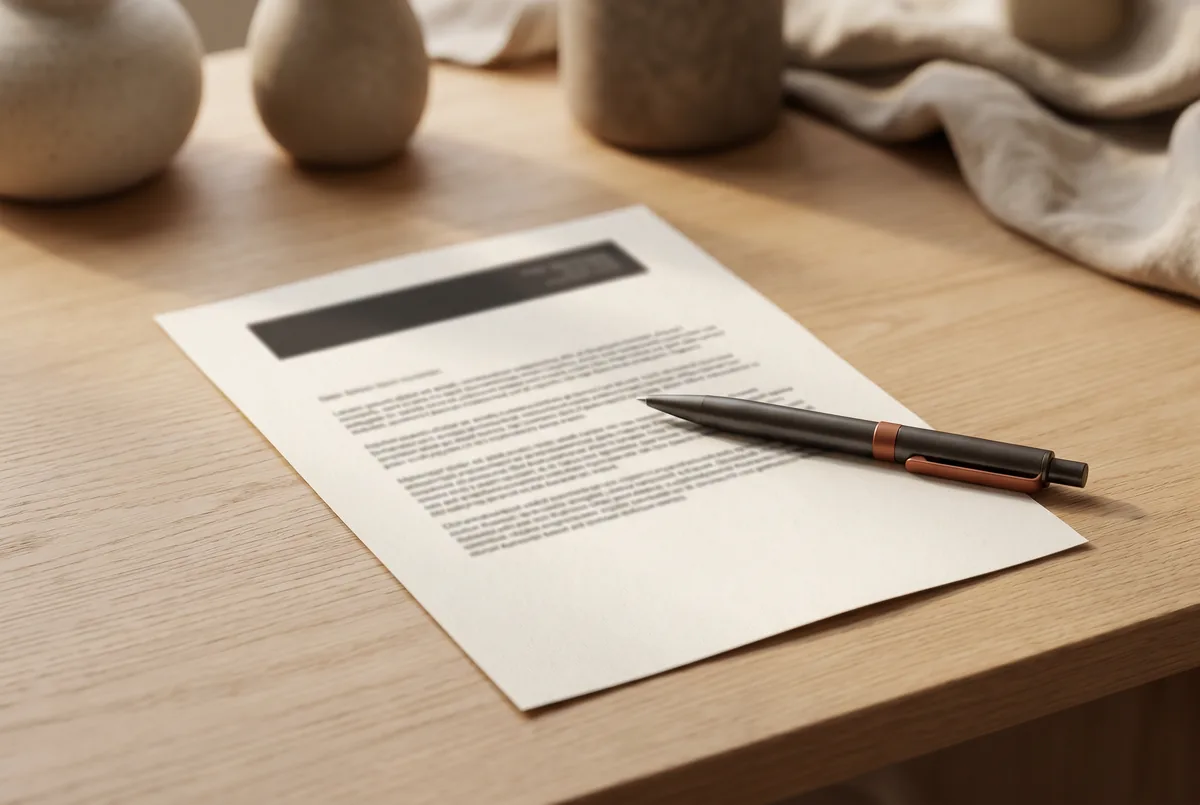
It all fits on one page. If you need two, you almost certainly have too much text or too little news. The contact details are the part most often forgotten and the one that kills the most articles: if the journalist wants to follow up and finds no one to call, there is no article.
How to write the headline and the lead
The headline decides whether the email gets opened. It has to tell the news, not hint at it. "A company bets on innovation" says nothing; "An optician chain opens its first store in Seville and plans to hire twelve people" does. The first could belong to anyone; the second only to you. Keep it under fifteen words, put in the concrete fact (a figure, a place, a name), and cut any word that smells of marketing. If it sounds like a brochure when you read it out loud, rewrite it. The journalist wants to copy your headline almost verbatim; make that easy.
The lead is the most important paragraph in the whole release. Many journalists read no further, so the entire news has to live inside it. The classic way to check is to answer the five key questions: what happened, who is behind it, when it happens, where, and why it matters. You do not have to answer them in that order or mechanically. It is enough that, once the lead is finished, a reader who knows nothing about you understands the whole story. If they have to keep reading to grasp what it is about, the lead is broken.
On the quote in the body: write it the way a person actually speaks, not like a slogan, and attribute it with a name and job title. A quote is there to add an assessment that has no place in neutral news. If it sounds like an internal memo approved by three departments, it adds nothing.
An example of a press release
To show the skeleton, here is an example with a fictional but plausible company. Pay special attention to the headline and the lead, which is where you win or lose the journalist.
Headline: An artisan bakery in Valencia opens its second workshop and adds ten jobs.
Lead: The bakery Horno del Turia opens a second workshop this week in the Ruzafa district of Valencia, expanding its sourdough production and creating ten jobs. The opening responds to rising orders from local restaurants over the past year.
Body: The new space will let the company meet restaurant demand without cutting sales at its original store. "We had been turning down orders for months because we had no room to bake," says Ana Ferrer, the founder. The workshop adds wood-fired ovens and keeps the slow fermentation process the company has used since it opened.
About Horno del Turia: Horno del Turia is an artisan bakery founded in Valencia that makes sourdough bread with local flours. It sells to the public and supplies restaurants across the city.
Contact: Ana Ferrer, [contact email], [phone].
With that, a journalist has the fact, the context, a quote and someone to call. They need nothing more to decide whether to run it.
Common mistakes that ruin a release
The same failures repeat again and again, and all of them are avoidable:
- Vague headline. With no concrete fact, it does not invite the open.
- Burying the news. If the good fact sits in the fourth paragraph, nobody gets there.
- Brochure tone. Adjectives, superlatives and marketing phrases cost you credibility instead of adding it.
- No verifiable data. News with no figures, dates or sources is hard to publish.
- Missing or broken contact. A generic inbox nobody checks kills the release.
- Too long. If it does not fit on a page, you have added things that are not news.
The honest bit: distribution versus one concrete outlet
Here it pays to be clear, because there is a lot of confusion. We do not distribute press releases. Sending the same text to hundreds of outlets at once rarely works: editors recognize the mass mailing and drop it, and the links that sometimes come out of that distribution tend to be nofollow and low value.
What we do is a different thing. If you want a guaranteed link on one specific newspaper or blog that you choose, that is a sponsored article on a single outlet, not distribution. We explain it in our guest post service, and if you want recognizable mastheads you can see how it works to publish on real newspapers. That link, on top of the reach, leaves you a backlink; if the term is new to you, we have a guide on what a backlink is and why it matters for SEO.
Writing the release well is half the job; the other half is where it lands. Make sure you have real news, tell it with the fact up front, and then decide with judgment where to publish it. One good outlet chosen with care beats a thousand blind sends.